Pehr Dubb Collection
A collection of great value to the history of medicine, and to local Gothenburg history. Originally these books belonged to the founder of the Sahlgrenska hospital, physician Pehr Dubb (1750-1832). The majority of the books are held at the Biomedical Library.
About the collection
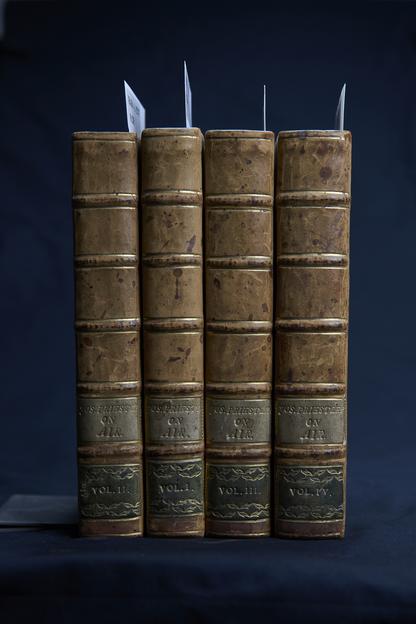
The Pehr Dubb Collection amounts to some 2 000 volumes on medicine, as well as other scientific literature, mostly within naturial sciences. The main portion of the collection consists of books and periodicals from the 18th and 19th centuries, but there are older titles as well, from as far back as the 16th century. Many of the books display Dubb's own signature, along with various marginalia and stamps. In keeping with his time, Dubb had several of the journals bound in hardcover - though in a highly personal and somewhat peculiar way, with the spine labels placed very low. At a cursory glance, this gives the impression that the books have been shelved upside down. In addition, it makes them very easy to spot among other, more conventional spines.
The collection mirrors the subjects that were most relevant in Dubb's day, and to his work: illnesses that plagued Europe, including various venereal diseases and the yellow fever. In addition, the collection holds books about ideas and inventions that were new at the time, such as electrotherapy and magnetism, field medicine and field surgery, hygiene, biology and technical inventions, among many other things.
Herman Boerhaave (1668–1738) was a Dutch physician and scholar conducting research within natural sciences. He is well represented in the Dubb Collection, with works such as the Tractatus de viribus medicamentorum (1723) and by proxy with the Genera morborum (1763) by Carl Linnaeus (1707–1778). Both works constitute classifications of various types of diseases. Linnaeus is held to be one of Boerhaave's acolytes.
Albrecht von Haller (1708–1777) was a Swiss physician, poet and botanist, whose works also feature in the collection. von Haller made various discoveries within physiology concerning the heart, the cardiovascular system, muscle contractions and more.
Among the many older works in the Pehr Dubb Collection is the De conceptu et generatione hominis (1554) by Swiss physician Jakob Rüff (1500–1558). This work has the first practically useful illustrations of obstetric instruments.
A few works in Swedish are also represented here, including some by Johan Lindestolpe (1678–1724). Several of his works were issued in Swedish, which was unusual at the time.
In the 1990s, the Gothenburg Society of Medicine provided means to furnish the "Pehr Dubb room", a dedicated space for the books of the collection, located at the Biomedical Library. Here, too, is a card catalogue of the collection. The catalogue has been scanned and made available through the BIOKAT. Since 2024, the collection is catalogued in Libris and Supersearch, retrievable with the search phrase ”Pehr Dubbsamlingen”.
Acquisition history
Pehr Dubb chose to sell parts of his library to the Sahlgrenska hospital. The collection, with materials from the 16th to the 19th century, was later divided into various categories after which the medical, scientific and other similar subjects were eventually relocated to the Biomedical Library.

Access the collection
The collection is held in the closed stacks of the Biomedical library. It is available for reading room use only.
Catalogue
Search for the contents of the collection using the phrase "Pehr Dubbsamlingen".
In Libris
In Supersök
In BIOKAT (scanned card catalogue).
Biomedical library
Medicinaregatan 4
413 90 GOTHENBURG
Phone: 031-786 30 02
Text:
Gustav Bäcklin
Biography
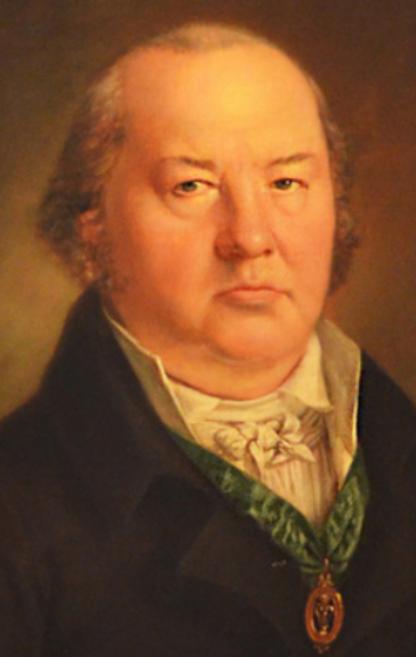
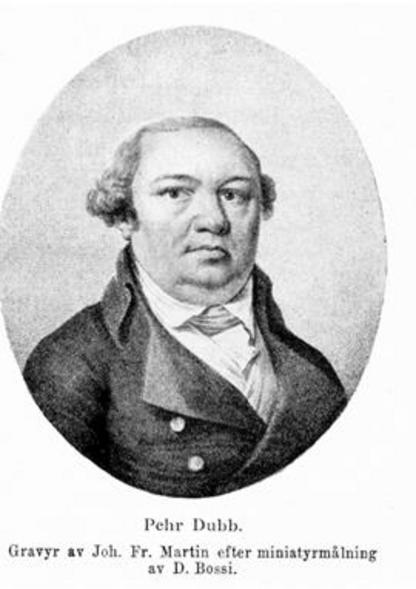
Pehr Dubb worked as a doctor in Gothenburg, and organised the establishment at the first Sahlgrenska hospital.
Dubb was born in Mariestad on January 14th, 1750 and died on January 6th, 1834. Early on, he held a fascination for natural sciences which brought him to Uppsala university where he studied under, among others, Carl Linnaeus. Following this, Dubb spent some time as a doctor for the poor at Sätra brunn, a health spa established in the 18th century, just north of Västerås. His dissertation concerned venereal diseases. Dubb moved to Gothenburg in 1778, and after settling on the West Coast, he spent some time in France, mainly in Paris, to study the organisation of hospitals there.
In 1782, Dubb was asked to organise the newly established Sahlgrenska hospital in Gothenburg, and in this endeavour his experiences from the French hospitals proved very useful. During his time at Sahlgrenska the number of beds more than doubled, while the care home he had made for the chronically ill freed up the hospital for more specialised efforts.
Despite his position he cared deeply and particularly, as personally expressed, for the city's workers and its poor - a stance that is said to be the reason for his dedication when it came to various humanitarian issues. He involved himself in the administration of the city's sanitation - a quite natural measure for preventing disease - and in the poor relief and the care for children, as well as many other things.
As physician, admiralty surgeon and co-founder of the Sahlgrenska hospital and the Swedish Society of Medicine (later the Gothenburg Society of Medicine), Pehr Dubb is a central character in both the history of medicine, and the history of Gothenburg.
Pehr Dubb received frequent requests to be the godfather at christenings, and thus earned the affectionate byname "Daddy Dubb" among the townsfolk. Much like the city's founding monarch, he became "rather portly in his later years", and at the end of his professional life, a footman was tasked to assist him in gaining access to the upstairs lodgings of poor patients, and pull him by a rope up the narrow stairwells.
Dubb is said to have been a man of practical fortitude, an enlightened despot who dominated his surroundings with calm dignity and a humorous disposition. He was "incessantly industrious, strictly punctual, and bluntly candid", as well as unflinchingly straightforward and obstinate in the face of any authorities who did not look to the common good in the same way he did.
As an aside, it is worth noting that Pehr Dubb was spared from seeing the cholera outbreak that taxed Gothenburg so terribly in the late summer and autumn of 1834, some six months after his passing.
* Many of the above details reference, with gratitude, the biographical post in SBL by D. Josephson and B. Hildebrand.

Read more
Björck, A. V. (1890). Katalog öfver Sahlgrenska sjukhusets bibliotek upprättad år 1890.
Förtekning på framlidne öfver fält-läkaren m.m. doctor Pehr Dubbs efterlämnade samling af böcker och chartor, som kommer att genom auction försäljas i Götheborg den mars 1834. (1834). Götheborg.
History of the Gothenburg Society of Medicine
Lönnroth, L. (2018). Doktor Dubb dikterar. Omsorg om fattiga barn i Göteborg 1800–1850.
The Medical History Museum of Gothenburg on older Gothenburg hospitals
Medical history map by the Sahlgrenska hospital
Stenström, Fritz. (1933). Per Dubb och hans livsgärning : ett ärofullt kapitel i Göteborgs läkarhistoria
Suggested research topics
- An overview of the collection's contents. What is represented here, and how does it mirror the time and context of the material?
- Biographical research
- Comparisons with other, similar historical collections of literature on medicine.
- Depictions of surgery in older literature.
- Instructive renditions of medical practice.
- Medical and anatomical illustration in history.
- The history of healthcare in Gothenburg.
Please contact us if you have any suggested research topics you would like to share!