Pontus Nybelin Book Collection
Travel literature, geography and ethnography, mainly from the second half of the 19th century and the early 20th century. The majority of the books, 304 titles, have been issued during Pontus Nybelin's lifetime, 1855–1935. The collection includes a few older titles, 65 of which are from the 18th century. Many of the works in the collection are lavishly bound in contemporary, decorated publisher's covers typical for the period.
About the collection
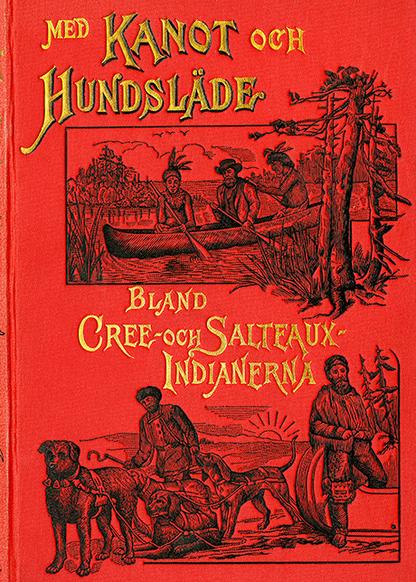
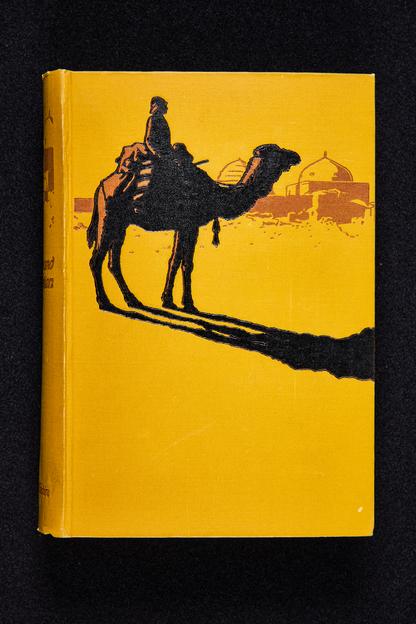
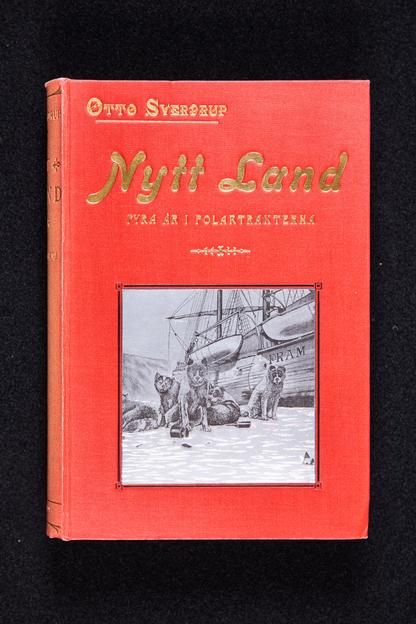
The Pontus Nybelin Book Collection consists of 462 titles. The majority of these are bound monographs, supplemented by a smaller number of booklets, as well as a handful of serial publications. The collection has both older works, beautifully decorated publisher's covers, heavily worn bindings, small low-cost pamphlets, and bound mass-market editions. Some of the books are in very poor condition, such as Aeneas Andersen's Berättelse om Ängelska beskickningen uti China (1796) which lacks covers altogether, and has nothing but a plain sheet of paper covering the body. Other books have fared much better, and have well-preserved embellished covers, such as Egerton Young's Med kanot och hundsläde bland Cree- och Salteauxindianerna (1894).
A few fragments of even older works survive in the collection, among them Nils Matson Kiöping's Een kort beskriffning vppå trenne reesor och peregrinationer, sampt konungarijket Japan (1674), likely assembled from pages taken from several different copies, but incomplete in spite of this.
The Nybelin collection, like many others of its kind, mirrors the time of the creation of its contents in many ways. Several of the titles have been prompted by expeditions, or by various political events. The prints on East Indian voyages in the 18th century were immediate products of the increased trade and driving colonial forces. The depictions of expeditions, hunting trips and military operations in Africa in the 19th century, such as the six titles by Henry M. Stanley present in the collection, or Peter Möller's Resa genom Angola, Ovampo och Damaraland (1899), are not only renditions of these lands, but an expression of 19th century colonialism. Möller was employed by the Association internationale du Congo, an organisation operating within the framework of the colonial ambitions of Belgium. In this way, the authors themselves mirror the opinions that permeate the cultural and political context of their time.
Another hallmark of the age of the collection is that it is made up almost exclusively of materials written by male authors. At that, two of only three works in the collection written by women have not been added to it by Pontus Nybelin. One of them, Osa Johnson's Mitt liv blev ett äventyr, was published in 1941, after Nybelin's death. The other, Östgöta-geografi (1927) by Anna Rothman has a written dedication from the author to Karin Nybelin. The one exception is the Dagbok under en resa till Egypten, Konstantinopel, Krim och Grekland (1870) by Theresa Grey, which is included in both inventories made by Nybelin, and consequently should have been acquired by himself.
Polar research
The themes featuring most prominently in the collection relate to the geographical discoveries of the 19th century. In many ways, this time saw the birth of polar research, and the collection has 77 titles on the North- and South Pole, Greenland, Spitsbergen, Iceland and the Faeroe Islands. Several of the great names of the 19th century can be found here, such as Fritjof Nansen with books including Fram öfver polarhafvet: den Norska polarfärden 1893–96 (1897) and På skidor genom Grönland: en skildring af den norska Grönlands-expeditionen 1888–89 (1890). In addition, there are works by Adolf Erik Nordenskiöld as well as several classic Greenland describers, including Knud Rasmussen and Hans Poulsen Egede. Greenland seems to have particularly fascinated Nybelin: 33 out of the 77 titles on the Polar regions concern Greenland.
Ethnography
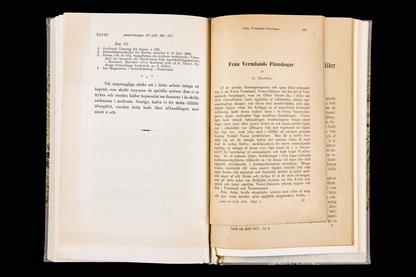
The interest in ethnological research, later ethnography, flourished in the second half of the 19th century. Renditions of people from various cultures or specific geographical places constitute another main theme of the collection, with about as many titles as those on the Polar regions. The ethnographic material primarily includes books and materials on the Sámi and Sámi culture, such as Om Lapparna och deras gudar (1848) by Joh. Henr. Schröder, or Olof Rudbeck's Nora Samolad eller uplyste Lapland (1701), which is also the oldest book in the collection. Another interesting ethnographic title is Pehr Högström's Beskrifning öfwer de til Sweriges krona lydande lapmarker (1746), which also features in the collection as a translation to German: Beschreibung des der Crone Schweden gehörenden Lapplandes (…) (1748). This is the only title present in the collection as two editions in different languages. The writings on the Finnmark of Sweden and Norway can also be grouped with this theme, with titles such as Fryksdals härad och Finnskogar i äldre tider (1877) by Jan Magnusson and Från Vermlands Finnskogar (1873) by ethnographer Nils Gabriel Djurklou. The collection further has books on various original populations from places outside the Nordic countries, including methodist missionary Egerton Young's Bland indianer i wigwams och vid lägereldar, and Bland menniskoätare: fyra års resa i Australien (1889) by Norwegian ethnographer Carl Lumholtz.
Geography
Europe is a dominant theme in the collection, featuring in 121 of its 462 books. European nations beyond the Nordic countries clearly held little fascination for Pontus Nybelin. Half of the books on Europe concern Sweden, and many of them fall within the Ethnography section. Just seven of the books on Europe concern areas outside the Nordic countries, with two titles about the Estonian island of Ruhnu, historically and culturally linked to Sweden.
North and South America, Central America and the West Indies are represented in 59 works, compared to Africa (61 titles) and Asia (77 titles). Some nations seem to have held greater interest than others to Nybelin. In the material on Africa, books on Egypt, Congo [sic] and Morocco are represented to a much greater extent than books on any other African nations. For Asia, Russia is the most prominently featured country, and as for the American continents, materials mostly concern the US. The books on Russia and the United States are clear indications that the nations themselves were not what Nybelin found interesting, but rather the Polar and ethnograpical topics he felt were relevant.
Sámi culture and the Finn forests
Sámi culture and the Finn forests were things that Nybelin cared deeply for, which might be the reason why many of the prints concerning them - frequently small pamphlets or articles and chapters from other works - are part of the material he made sure to have bound in hardcovers. Nybelin's method of gathering and binding in various small prints is also something particular to the collection. In addition, he annotated the books, wrote his own tables of contents, noted the lack of maps or other materials in the works, corrected erroneous details, wrote out authors' names if that information was missing, and collected newspaper clippings that touched on the topics of his books. He placed the clippings between the relevant pages of the respective works.
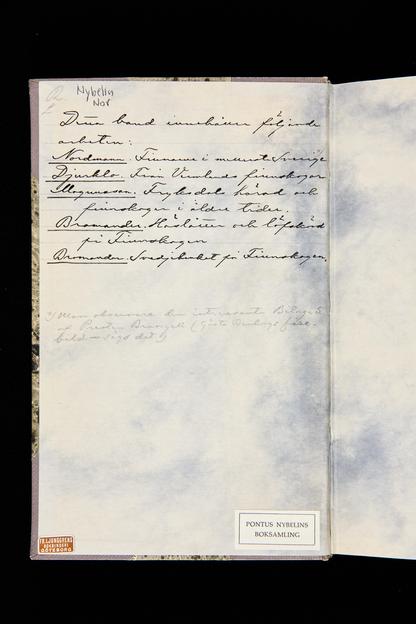
Another detail reinforcing the impression of a collector guided by interest and curiosity is the volume Om swenska Lappmarken och dess inwånare, by J. A. Linder. This booklet consists of a series of articles from Läsning för folket, issued in 1849–1854, which in this case have been bound as a single volume, with a cover made from lined paper with the title and a reference written on it. The page numbers have been corrected by hand for consistency. Sammelbände of this type occur throughout the collection, and some of them have hard covers commissioned by Nybelin. One volume displaying several of the oddities of the collection is one sammelband with materials on the Finn forests: five different texts bound in one volume by the Ljunggren bookbinder's workshop. Nybelin, whose name is written on the title page of Petrus Nordmann's Finnarne i mellersta Sverige (1888), has noted the year of the author's death, 1923, under the author's name. A typewritten, stencilled list with the heading ”Nödbröd i Wermland på 1800 talet” ("famine bread in the province of Värmland in the 19th century) is enclosed inside the covers, alongside a newspaper clipping from the Göteborgs Handels- och Sjöfartstidning 28/8 1917, concerning life in Värmland in 1762.
Acquisition methods
The inventory that Nybelin kept of his collection shows that he bought the majority of the latter's contents. Despite the fact that he never noted the date of purchase, he did notice the purchase price. There are some examples of other acquisition methods. Johann Anderson's Efterretninger om Island, Grønland og Strat Davis till Videnskabernes og Handelens sande Nytte (1748) bears the note: ”Tillbytt af Göteborgs stadsbibliotek mot ett bättre ex. af samma arbete” - exchanged with the Gothenburg City Library for a better copy of the same work. The provenance illustrates how book collectors and libraries interact when building collections. The title in question originally came from the shelves of bibliophile and book collector Lars Månsson in Tranemåla. His collection was acquired by the Gothenburg City Library in 1898. The Tranemåla collection included a great many titles already present in the library's holdings, and significant portions of the former were subsequently sold in ten duplicate auctions held between 1904 and 1907. It is clear that the library also engaged in publication exchange, such as when Pontus Nybelin swapped his copy of a title for another copy of the same book, from the Tranemåla collection. Through his donation, the exchanged volume was once again made part of the University Library holdings.
Provenances
Nybelin's collection also grew through gifts from his family and friends, as well as various authors. One example is Tacitus' Germanerna (1916), a Christmas gift from Orvar Nybelin to his father in 1916. Here, too, is Knud Rasmussen's Grönländska myter och sagor (1926), a gift from Orvar and Karin to ”vår älskade pappa Pontus med önskan om snar förbättring” (our beloved papa Pontus with best wishes for swift recovery). Runa-list (1875) by Claës Johan Ljungström is a small booklet on how to read and write runes. If this work once belonged to Nybelin the elder or Nybelin the younger is not established, but it has at least been present in the collection during Orvar's childhood, as at some point he has written, in a juvenile hand, ”Orvar Nybelin, Göteborg” in runes on the title page. To a certain degree, Orvar Nybelin continued to expand the collection. Among the titles introduced by him is Antarktisboken by John Giæver and Valter Schytt (1952), signed by three of the members of the expedition described in the book.
Some of the unknown names in the books also contribute to the history of the collection. In William Bligh's Engelske capitainens Wilhelm Blighs resa genom södra werld-hafvet (1792), printed in Uppsala, the endpapers are filled with writing, mainly by Amanda Josefina Nilsson who seems to not only have been practising her signature many times, but to have done posterity a solid favour by noting "This book belongs to me Amanda Josefina Nilsson on Walnö [island], born 14 October 1861”. Thanks to these details, we can establish her identity: the daughter of Sofia Johannesdotter and navigating officer Abraham Nilsson. We can follow her from Valön to Gothenburg. This is part of the book's history, as is the detail of its printing in Uppsala by Catharina Elisabeth Edman, and its previous owners who have also noted their names in it: apart from Amanda there is Fredrike Mathilda Holst, Wilhelmina Hemning and Nicl. Osterdahl, Pontus and Orvar Nybelin and eventually the Gothenburg University Library. The three women who have noted their names in the above edition of Bligh's journey contribute to the visibility of women in the historical readership of travel literature, despite the fact that the collection - if perceived only as a list of titles - is almost exclusively male.
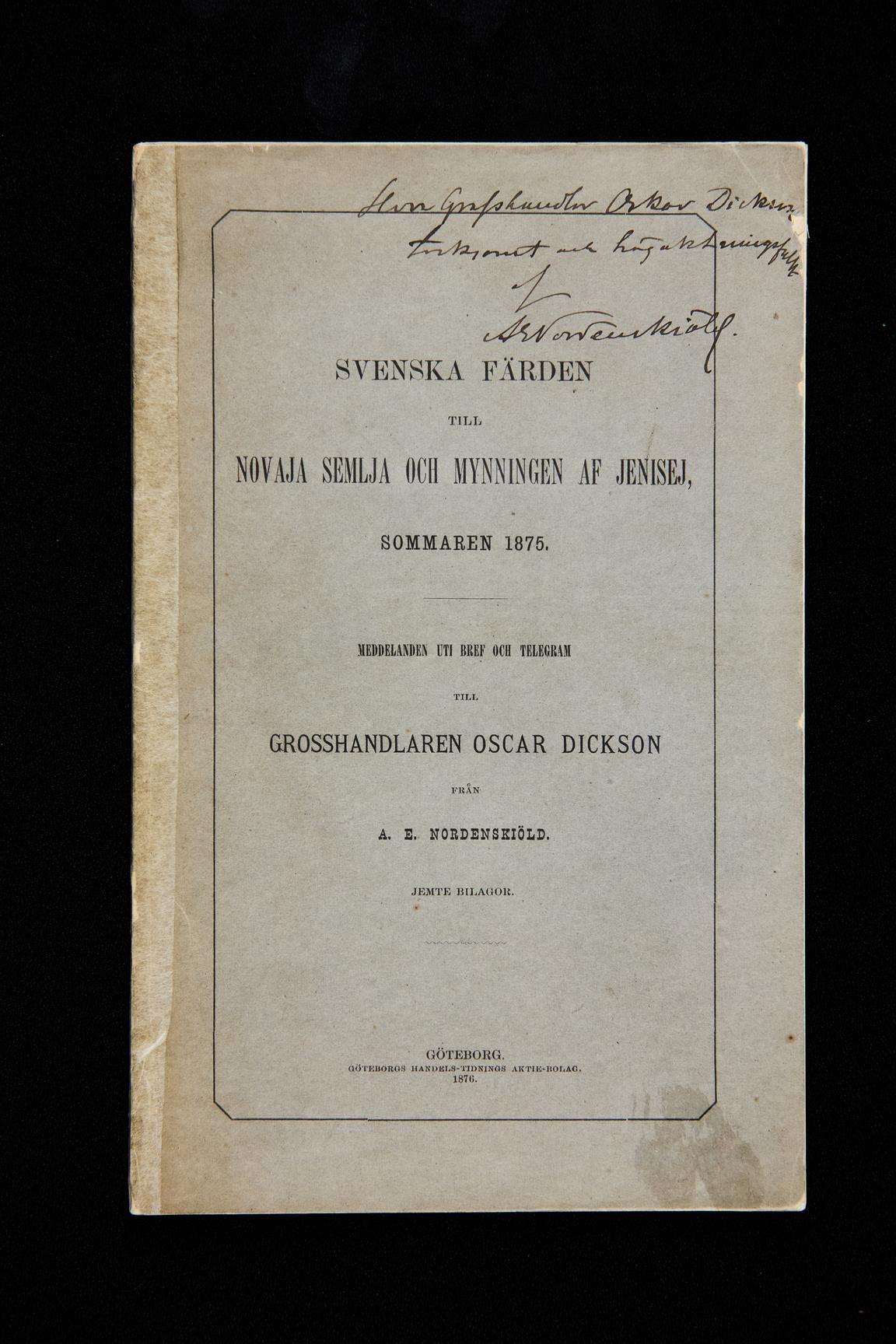
There are a few examples of prints that Nybelin has struggled to acquire, which prompted him to pay a visit to the then Gothenburg City Library, to make his own manuscript of the library's copy. One of these books is the Svenska färden till Novaja Semlja och mynningen af Jenisej, sommaren 1875 (1875) by Adolf Erik Nordenskiöld. However, this title was later acquired by Pontus Nybelin at an auction: a copy that had previously belonged to Oscar Dickson and had been signed by A. E. Nordenskiöld.
19th century travels
In the 19th century, the opportunities for communication underwent monumental change. Travel was made easier and more affordable, resulting in an increasing number of people moving about within the country and outside it. Those who did not travel could still partake in the new touring, thanks to the increased dissemination of budget-friendly printed matter. Mass tourism kicked off in the second half of the 19th century, sparking in turn a lot of location-specific travel guides and other prints. The fact that the Pontus Nybelin Book Collection specifically consists of travel literature and geographical depictions mirrors the development described above, not least the fact that travel - for colonial purposes, for science and on an individual level - did not just increase in general, but also gained much more attention in print. Pontus Nybelin's eleven motley metres of geographical renderings showcase this tendency of the mid- to late 19th century.
Acquisition history
The collection was donated to the University Library in 1966 by professor of zoology Orvar Nybelin, son of Pontus Nybelin. The book collection was described by Orvar as containing ”travel books, brought together by my father”, which isn't strictly accurate, since both Orvar Nybelin and his wife Karin contributed additional titles to the collection. In its entirety and for the most part, however, it is the work of Pontus Nybelin.
The collection was placed as a deposition at the University Library by Orvar Nybelin, formally until 1982. In connection with the drawing up of the official deposition contract in 1969, an inventory of the collection was also made. When the collection finally became the official property of the library in 1982, 13 of the titles in the inventory were missing. The collection includes two notebook with Nybelin's own inventories of all his books, meaning not just the ones that are part of the current collection. These inventories display a palpable interest in nature, represented by books on plants and birds, but the great majority of the books concern geography and ethnography, and these are the titles that were donated to the library.

Access the collection
Text:
Stefan Benjaminsson
Biography
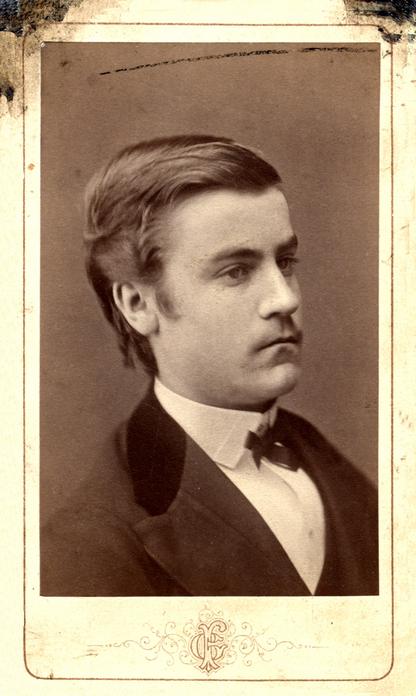
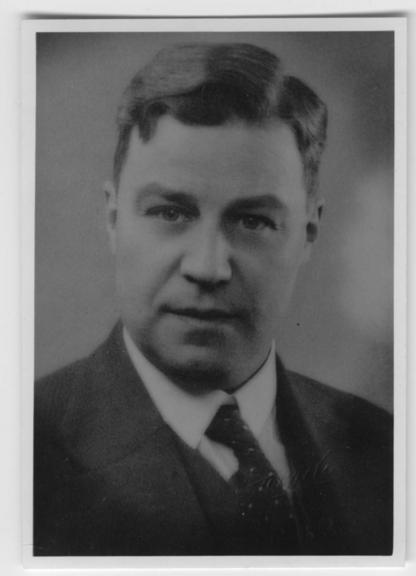
Pontus Nybelin was born on February 17th 1855 in Karlstad; the son of merchant Henrik Nybelin and his wife, Johanna Maria Nybelin. Pontus married Emelie Gornitzka, born 1863 in Kongsvinger, Norway. They had three children: Orvar, Lina and a firstborn son, Ragnar, who died in infancy.
Pontus Nybelin attended the Karlstads högre elementarläroverk. The languages taught to the students were German, English, French, Latin, Greek and Hebrew. Nybelin studied Latin, but it is unclear whether he was schooled in any other language. It is likely he was not particularly proficient in any language besides Swedish, at least he seems to have disregarded languages beyond the Nordic ones as far as his reading habits indicate. The books in his collection are more or less exclusively in Swedish; out of the 462 titles, 388 are in Swedish, 34 in Danish and 24 are in Norwegian. The school had exempted him from singing which was otherwise part of the curriculum, so it can be assumed he had not been gifted with any particular voice talent.
In October 1874 Nybelin moved to Råda in Värmland, to be employed as a works accountant, and this is how he made his living for a number of years on, including at the Dejefors works. In 1881 he moved to Hagfors to work as an inspector at the Nordmark-Klarelfven railway in Hagfors, and he also served as an agent of the Skandia insurance company, a profession he later maintained parallel to his trade business in Gothenburg.
In 1888 Nybelin became a partner of Meurling & Co. in Gothenburg, and later in the same year he gained full ownership of the enterprise, running it from then on as Meurling, Nybelin & Co. Nybelin was a merchant from this point, mainly trading in herring until 1924 when he discontinued the business. In the early 1930s he moved to Äppelviken in Stockholm, where he resided until his death in January, 1935.
According to the biographical notes on his son Orvar in the Svenskt biografiskt lexikon, Pontus Nybelin was a ”keen amateur botanist”. This interest is evident to some degree when studying the titles of the inventories he made of his books. However, the book collection as such gives few or no signs that Nybelin himself was well travelled, other than possibly by going places where he might have had personal connections.
It cannot be established when Nybelin first began collecting books, but it is clear that he was a collector early on, judging by an ad in the Wermlands Läns Tidning from 1872, where he advertised at 17 years old about a ”larger collection of coins” in his possession. Värmland is the only geographical theme of the book collection that can be associated with the biography of Pontus Nybelin. Among the books on Sweden, Värmland is somewhat overrepresented. The only novel in the collection, Maximillian Axelsson's Gruf-arbetarne: romantisk skildring ur Vermlänningarnes folklif (1881) is set in Värmland.
It is through Värmland that Nybelin's interest in geographical renditions is revealed, in an article he wrote for the Svenska Turistföreningens årsskrift 1888. Here, he describes the area surrounding Uddeholm: Uddeholmsverken med omgifningar (Wermland). Via this article, we have some possible insight into Nybelin's own library. The text mentions two other authors of geographical works: ”På högra sidan, strax bortom U. synas några rödmålade byggnader – Stjern, bekanta från Engelsmannen Lloyds jagter. L. hade här under en lång följd af år sin bostad och högqvarter och hans son, den framstående afrikaresanden Charles Anderson föddes här.” Both these authors can be found in the collection. Llewelyn Lloyd was a Welsh amateur biologist who lived in Sweden, mainly in Värmland, for a couple of decades. His Field Sports of the North of Europe: comprised in a personal narrative of a residence in Sweden and Norway, in the years 1827–28 was first published in 1830. It is the second, revised and expanded Swedish edition from 1883, Jagt-nöjen i Sverige och Norge, which can be found in Nybelin's collection. The copy has a small paper tag pasted into it, measuring about 2x5 cm, with the signature ”L Lloyd”. Next to it, Nybelin has penned ”Lloyd's signature”. At some point, the book has been given new covers at the Ljunggren bookbinder's workshop, and two stencilled sheets have been added to it at this time; an excerpt from Fritz von Dardel's Minnen including an anecdote about Lloyd. Charles Anderson is represented with two titles in the collection: Floden Okwango: resor och jagtäfventyr (1861), and Sjön Ngami: forskningar och upptäckter under fyra års vandringar i sydvestra Afrika (1856). It is not unfeasible that the books were already in Nybelin's possession when he wrote the article.
Read more
Benjaminsson, S. 2021, Om konsten att läsa en boksamling: Pontus Nybelin och 1800-talets reselitteratur I: Svensson, Anna (ed.), Objekt och samling: om det unika i Göteborgs universitetsbibliotek, Göteborgs universitet, [Göteborg], 2021
Carina Lidström, Reseberättelsen i Sverige
Suggested research topics
- An overview of the collection's contents. What is represented here, and how does it mirror the time and context of the material?
- Biographical research.
- Comparisons with other similar collections.
- Renditions of travel in older literature.
- Polar expeditions in fact and fiction.
- Provenances in the collection.
Please contact us if you have any suggested research topics you would like to share!