The 1868 Swedish polar expedition
A. E. Nordenskiöld enters the polar arena.
After returning home from the 1864 expedition to Spitsbergen, it was not long before Nordenskiöld made plans for the next journey to the Arctic. The state interest in this kind of polar journeys had waned in the 1860s, and Nordenskiöld realised he must turn elsewhere for support. He writes: "After a few failed probes in other directions, I turned to County Governor Count Ehrensvärd in Gothenburg, solicitous in matters concerning science, arts and literature, presenting the main points of my travel plan, and a request that he would try to acquire in Gothenburg the considerable economic means needed for its execution." Albert Ehrensvärd took the matter in hand, and soon engaged a number of patrons with names such as Dickson, Ekman, Carnegie and others, to act as sponsors for what would become the 1868 Swedish Polar Expedition to Spitsbergen.
After securing the economy of the expedition with the aid of the Gothenburg sponsors, the preparations for the journey were swiftly made, and for his expedition vessel, Nordenskiöld could claim the steamer Sofia, originally built for postal services in the Baltic Sea, but now provided as a loan from the state for the use of the polar expedition. Expedition members Theodor Magnus Fries and Carl Nyström write in their accounts: ”There should be no need to remark in particular that here, in Gothenburg, in what we might call the cradle of the exhibition, the same has been subject to the most heartfelt well-wishing and attention, both regarding the endeavour as a whole and when it comes to its individual members. Each participant on this voyage must surely treasure forthwith the memory of joyous days spent here, as well as the many tokens, great and small, of good will and engagement presented in that time. ... But regardless of all this hospitality and kindness, we all longed fervently for the moment we would finally leave Gothenburg, and initiate the journey northwards. At last the steamship arrived, which brought from England the prescribed, utterly necessary scurvy preservative, 'lemonjuice', and a few hours later we left the Gothenburg harbour on July 7th, at three in the afternoon, cheered on by the well-wishes and hurrahs of our friends and benefactors, thronging on the beach. We set out for Marstrand first, where the deviation of our compass needles was determined, and the Sofia made for the open sea, after having first been greeted by the music and cheers of the assembled resort guests on the beach, and letting ashore author August Blanche who had accompanied us from Gothenburg and was now laden with letters and telegrams for friends and kin back home. Soon, the contours of Sweden's coasts faded into blue, and sank beneath the horizon."
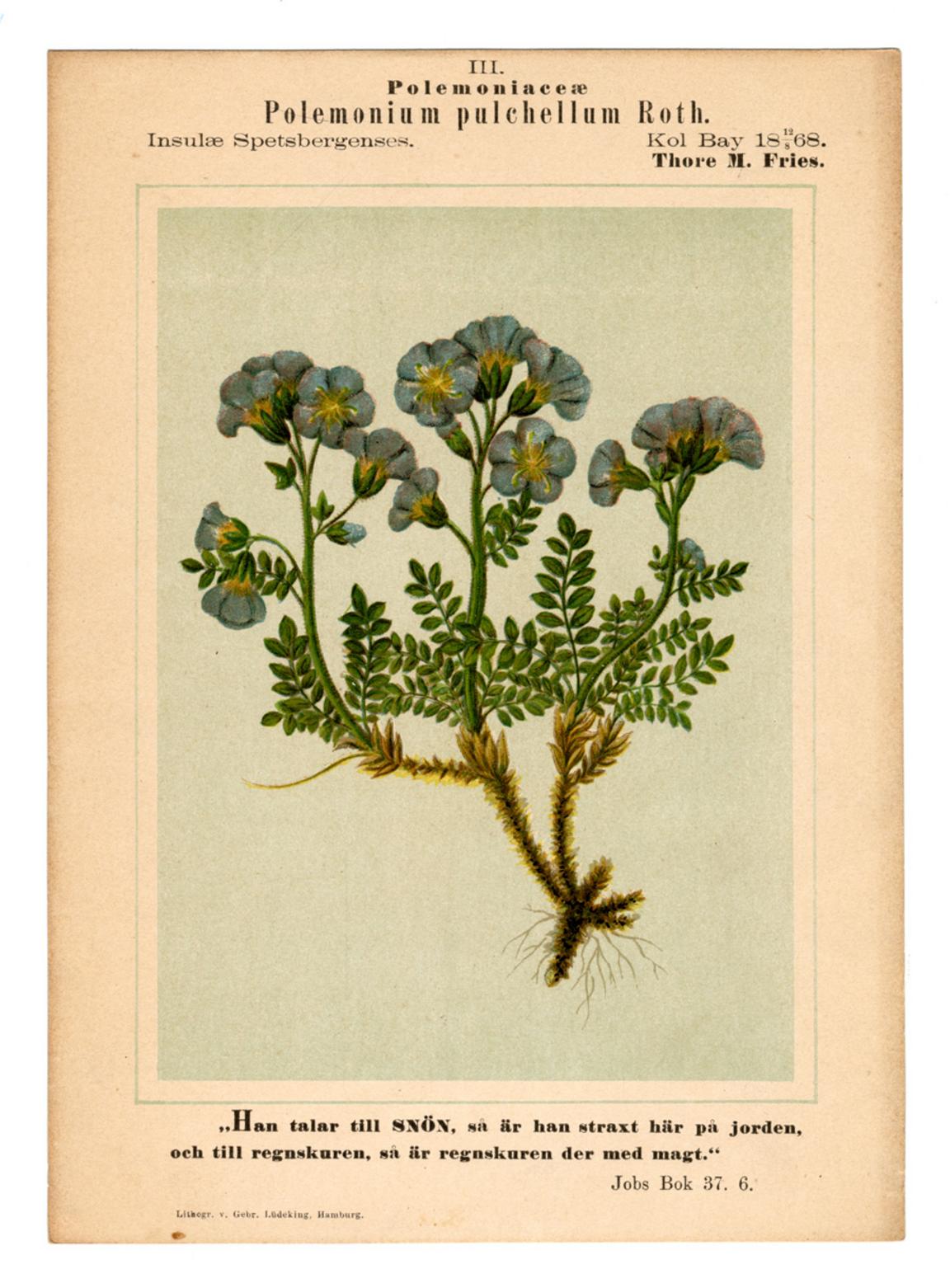
The scientific crew consisted of A. E. Nordenskiöld (1832–1901), expedition leader and geologist, August Emil Holmgren (1829–1888), zoologist, Anders Johan Malmgren (1834–1897), zoologist and botanist, Fredrik Adam Smitt (1839–1904), zoologist, Sven Berggren (1837–1917), botanist, Theodor Magnus Fries (1832–1913), Selim Lindström (1838–1904), physicist and Gustaf Nauckhoff (1847–1919), geologist and mineralogist. Commander of the ship was Captain Fredrik Wilhelm von Otter (1833–1910) and the ship's physician was Carl Nyström (1839–1913).
The expeditionen arrived via Björnön to Spitsbergen where extensive scientific work was carried out during the summer, yielding rich results. Beyond botanical and zoological studies, far-ranging geological examinations were undertaken in the area surrounding Isfjorden and Kap Thordsen. During the second half of August, the expedition found themselves in the northwestern parts of the group of islands, where the ship was anchored in Kungsfjorden. From here, the members travelled further north towards Kobbebukta on Danskön and furhter onto Smeerenburg on Amsterdamön where the remains of the old Dutch whaling industry were examined. Here, the expedition was divided into a land-based group and one that carried on aboard the Sofia, conducting research on the sea outside the coast. During its voyage, the Sofia reached 81 degrees 42 minutes north on September 19th, which was then the record for ships, thereby breaking the record of William Scoresby of degrees 30 minutes north from 1806.

However, Sofia was damaged by the ice on October 4th, and the expedition was forced to enter Kungsfjorden on the northwest coast of Spitsbergen to repair the vessel, and as it was already late in the season, it was decided that the expedition should now return south. On November 15th, 1868, the Sofia arrived back in Gothenburg with a somewhat dented hull and tattered rigging.
The scientific results included, among other findings, maps of northern Isfjorden, Liefdefjorden and Woodfjorden. Extensive botanical and geological work had also been made, as well as soundings of the nearby sea, which indicated the presence of a deeo Polar sea, something that was later confirmed by Fridtjof Nansen during the Norwegian Fram expedition of 1893–1896.
Bibliography
- Fries, Th. M. and Nyström, C. "Svenska polar-expeditionen år 1868 med kronoångfartyget Sofia : reseskizzer", Stockholm, 1869
- Fries, Th. M. and Nyström, C. "Svenska polar-expeditionen 1868 med kronoångfartyget Sofia : Reseskizzer", Stockholm, 1869.
- Nordenskiöld, A.E. 1868 års svenska polarexpedition, Framtiden. Tidskrift för fosterländsk odling. Vol. 2, pp. 642-657, 1869
- Nordenskiöld, A.E. 1868 års svenska polarexpedition, Framtiden. Tidskrift för fosterländsk odling. Vol. 2, pp. 642-657, 1869 (PDF)