The Björling-Kallstenius expedition to northeastern Greenland, 1892
A Swedish polar tragedy
A forgotten Polar tragedy. That is no exaggeration when describing the expedition of Swedish botanist Johan Alfred Björling (1871–1892) and his friend, Uppsala student Evald Götrik Kallstenius (1868–1892), to the area around the Smith sound in the summer and autumn of 1892. In 1889, Björling had become the first Swede to climb Kebnekaise, and he had later participated in the Spitsbergen expedition of Gustaf Nordenskiöld (1868–1895) in 1890. In the following year, Björling made a solo expedition to northwestern Greenland, with the intent to continue the studies he had begun in the previous year, as well as to examine the polar basin north of North America, which was less well known at the time.
The expedition left Stockholm in May 1892 and travelled via Gothenburg to Liverpool, and then to St. John's in Newfoundland. Here, the Ripple was bought for the expedition - a 37 ton schooner. Björling also succeeded in hiring three crewmen: Herbert McDonald, Gilbert Dunn and Karl Kann. It was not until June 24th that they could leave St. John's and head for Godhavn, present-day Qeqertarsuaq, in Greenland where they arrived on July 28th. In other words, the hour was getting late, and in Godhavn there were unsuccessful attempts to talk Björling into postponing the expedition until the following year.
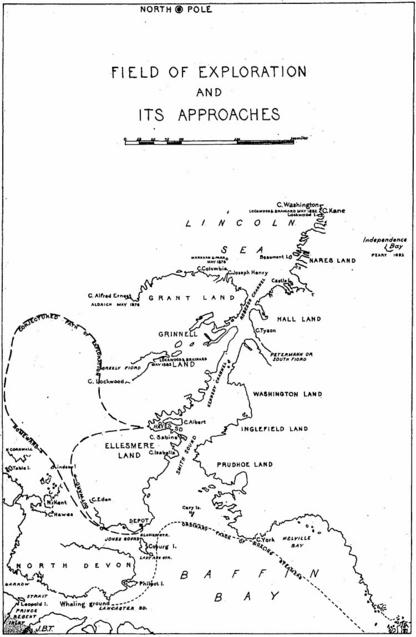
On August 2nd, the Ripple sailed across Mellville bay towards Cape York. What happened to the expedition after this point remains, in part, a mystery. There is some information to be had from a few notes made by Björling and found in the following year on the desolate Carey island in the Smith sound, by the skipper of the whaler Aurora. The wreck of the Ripple was also found, stranded on one side of the island. Björling's notes include three cards and one letter with information to any potential rescue operations. In the first card, he instructs members of the expedition of American Robert Peary, which was in northwestern Greenland, to leave information for the Rev. Dr. Harvey, of St. John's.

In another card dated August 17th, Björling writes: "Visited southeast Cary-Island on Aug 16th 1892. Left Godhavn on the 2nd of this month and sailed along the ice of Baffin Bay until the 13th, after which I [in] a single day day sailed across Melville Bay to Cape York. An easterly storm near the latter made me drift westwards, and by midday I found myself near Cape Parry, from where I sailed across to the Cary-Islands to acquire some food from the English provisions depot." The next day, Björling has added the following in pencil: "After we had taken the provisions aboard from the Nares depot, the Ripple was stranded on the south side of this island, where you shall find us in a small tent. A new message will be placed here, before we leave the island." The third card reads: "Since I lost the ship and was thus forced to overwinter, I left this island on Aug 27th, setting out for the Foulke fjord. If I should be forced to go from there to another place, any further information will be laid down at Pandora Harbour. Counting the provisions from the Nares depot in this place, I hope to have enough food to sustain myself and my companions until June of 1893."
The last message from Björling consists of a somewhat longer letter, dated October 12th, 1892: "To visitors of southeast Carey Island 1893. As you can see by my messages, I have attempted to reach the Foulke Fjord after the loss of my ship, and to spend the winter there, but after reaching Northumberland Island, I have been forced for several reasons to abandon that journey and return to Carey Island. Forced by inclement weather to remain a long time in this island, I now set out for the Eskimos at Clarence Head or Cape Farady on Ellesmere Land. As I hope that a whaler will visit Carey Island next summer to rescue me and my companions, I will try to reach this island before the 1st of July. If no one has arrived here before July 15th, I must, if possible, try to reach the Danish colonies. Thus, if you visit this island later than July 1st, and cannot find any message from me about my journey to the Danish colonies, I would be much obliged if you would go to Clarence Head (50 English miles from here) where I will leave a message in a stone cairn on the easternmost point, about the fate of me and my companions through the winter.
Finally, I would ask that you send a message from me to Professor Frhr. A. E. Nordenskiöld in Stockholm, or to the nearest Swedish consul, and inform him about where and when this message was found. Our supplies shall, if I cannot find any Eskimos, last us no longer than to the first of January, unless I can replenish them from some provisions depot. We are now five men in all, one of us dying. Southeast Carey Island, October 12th, 1892. J. A. Björling, Swedish naturalist.”
Unfortunately, we know very little about what happened after this. Björling seems to have wanted to stick to his original plan and go west in the longboat towards Ellesmere Island, instead of the Greenland coast, where they would likely meet with other people, and survive. It was not until the summer of 1893 that whaler Aurora visited Carey Island. The telegram about the finds did not reach Sweden until November in that year, when it was already too late in the season to outfit a search expedition to the area. Not until 1894 could the sufficient funds be raised - among the contributors were merchant Oscar Dickson in Gothenburg who donated 5 000 SEK to equip a search effort. Forest officer Elis Nilsson was thus given the opportunity to travel aboard a whaler from Dundee that usually sailed these waters. However Elis Nilsson made no finds that could shed light on the disappearance of the expedition. Later in that year, the area was visited again, when zoologist Axel Ohlin accompanied the Peary Auxiliary Expedition to make another attempt to find traces of the lost expedition. The crew landed in Carey Island and managed to retrieve certain objects. They also reburied the expedition member who had died on the island in 1892, and who had been mentioned in Björling's letter. Following this, they crossed the Smith Sound onto Ellesmere Land, where the placed Björling had mentioned were visited: Cape Faraday and Clarence Head. No trace of the expedition was found in either of these places. It is likely that Björling and Kallstenius never made it here, but perished on their way to Ellesmere Land, in the Smith Sound, which is filled with ice and difficult to cross.

Axel Ohlin returned home, and there was nothing more to do, except to conclude that the expedition was lost, and add it to the list of unsolved Polar mysteries. The families of the lost crew remained, forced to live without any certainty as to what had happened, and with the faint hope of potential future finds to shed more light on the events. Later on, Björling has been criticized for embarking with inadequate equipment on a mission he did not master in full, thus causing the death of several people. A. E. Nordenskiöld was likewise contested for having encouraged Björling to engage in such a risky project.
Anders Larsson
Bibliography
- Bryant, H. G., The Peary Auxiliary Expedition of 1894. Bulletin of the Geographical Club of Philadelphia. Vol. 1, 1895
- Jonasson, S-Å. "Björling-Kallstenius polarexpedition 1892. Minnesutställning på Kulbackens museum i Västervik 6 maj-2 september 1990", Västervik, 1990
- Kallstenius, A."Tragedin Smiths sund. Björling-Kallstenius expeditionen 1892", Stockholm, 1966
- Kjellström, R. Expeditionen som försvann. Om Björling och Kallstenius expedition till nordvästra Grönland 1892. In: Kjellström, Rolf, Breven från Arktis. Några brev och dagböcker från Arktis 1834-1926, Stockholm, 2003
- Nordenskiöld, A. E., Åtgärder för uppsökande och eventuelt undsättande af Björlings och Kallstenii expedition till Grönland. Ymer, issue 14, 1894.
- Nordenskiöld, G. Om Björlings och Kallstenii expedition till trakten af Smith Sound. Ymer, issue 14, 1894.
- Ohlin, A. "På forskningsfärd efter Björling och Kallstenius. Strödda dagboksanteckningar från en färd till Nordgrönland sommaren 1894", Stockholm, 1895.