Swedish Polar History Web
This website presents Swedish Polar history from 1860 to 1980. It presents various resources for further research, including both Swedish and international materials from various libraries and archives. The website is particularly aimed at researchers within social and cultural sciences, as well as the humanities.
About the Swedish Polar web
Mankind in the Polar regions
In 1882–1883 the first Polar Year was initiated, with the purpose of exploring the basic geographic layout of the Polar regions. Where were the respective land masses? Which areas were seas? Some international co-ordination was undertaken. The second Polar Year, 1932–1933, was meant to serve as a follow-up of the results from the previous Polar Year, but did not gather the number of research expeditions originally intended. The third Polar Year underwent a name change for various reasons, and was instead referred to as the International Geophysical Year (IGY), launched in 1957-1958. It centered largely on research concerning the upper atmosphere, and by extension communications and space technology. 70 nations participated in the effort, and the Sputnik project carried out by the Soviet Union shocked the world.
The International Polar Year of 2007–2008 commemorated the International Geophysical Year (IGY) of 1957–1958, and resulted in a great many new research and information projects concerning the Polar areas, once more with participants from all over the world. New technology and a new generation of scientists were in place, and today, the Polar regions are extraordinarily important to the research on climate change and environmental impact factors.
Compared to the previous Polar Years, the fourth instalment was unique as the research community decided to include the "human dimension" into Polar research - after several lengthy discussions. The people who had lived in the Arctic regions for a long time were now given the opportunity to participate in the research, and present their own urgent research problems concerning health, residence, education and social welfare. The work of scholars within the humanities and social sciences was also accommodated in the project, touching on many things including research history, history, languages, politics and more.
Beyond the usual grants, the Swedish Research Council provided earmarked funding specifically for the "human dimension". A dedicated team was established to gather scholars within the humanities, social sciences and cultural studies.
Anders Larsson, first librarian at the Gothenburg University Library, received a grant to fund an exhibition on Gothenburg as a past and present Polar research node. It was hosted by the Gothenburg Maritime Museum and Aquarium in 2008, along with other Polar related research, jointly titled Iskalla uppdrag (Ice cold missions), and was later displayed in Umeå. Several series of lectures were held parallel to the exhibition. Further funding was provided for building an online portal covering Swedish Polar research until 1980, mainly aimed at researchers and others with an interest in the humanities, social sciences and cultural studies.
Neither exhibition nor online portal would have been possible without the close collaboration of the Gothenburg University Library. First librarian Anders Larsson has written the texts about the history and exploration of the Polar regions, and about a number of important Swedish Polar expeditions. Besides various researcher biographies for the portal, he has also provided the sections on Polar regions in art, literature, music and theatre, and the chronology of the general exploration history of the Arctic and Antarctic. University librarian Gunnar Holmlund has provided and collated all links available through the portal, presenting literature, journals and archives relevant to the humanities and social sciences. Along with IT technician Lennart Stark, he has been responsible for the technical work in launching the portal online. Another key contributor has been professor emeritus Aant Elzinga, of the Department of Philosophy, Linguistics and Theory of Science at Gothenburg University. He has provided researcher biographies and expedition accounts, and has been highly invested in the portal project alongside Anders Larsson and Gunnar Holmlund. Bo Strömberg has provided vital information for the groundwork of the Gunnar Hoppe biography. Late Professor of Photography Tyrone Martinsson of HDK-Valand Academy of Art and Design was tasked to provide and edit all photographic materials. Our heartfelt thank you to Professor Per Holmlund, Stockholm University, to the Royal Swedish Academy, Stockholm, and to Håkan Jorikson at the Grenna Museum Polarcenter who have provided several of the photos used.
In creating this portal, we hope that humanities scholars, social scientists and the interested general public might find it a bit easier to discover many of the archives and libraries throughout which the Polar history is scattered, in the form of letters, photos, books and all manner of archival materials. A good place to start is the collections of the Gothenburg University Library.
Creators:
The texts have been written by Anders Larsson, senior librarian at the University Library of Gothenburg and by Professor em. Aant Elzinga. Technical work has been done by Gunnar Holmlund, librarian and Lennart Stark, technician. Ph D Tyrone Martinsson has selected and elaborated all photos.
The photos and maps are mainly from private collections, but also from Gothenburg University Library and Grenna Museum Polarcenter. Associate Professor Lisbeth Lewander was the project leader of this website, funded by the Swedish National Council for Research.
Swedish Polar research
Sweden's geographical location in Northern Europe, with part of its territory above the Arctic Circle (the latitude at 66° 30' N), has prompted a longtime Swedish interest in the Arctic and Subarctic regions. The interest has been motivated by both commercial and scientific factors. In addition, Sweden has an indigenous Arctic population, just like Norway, Finland and Russia - the Sámi people. In later years, the Arctic region has become a focal point in an entirely new way. This is due to the large amounts of natural resources including fossil fuels, metals etc that have become more exploitable through the increased melting of the polar caps, as a result of ongoing climate change.
The Swedish presence in the Polar regions has been prompted both by commercial and scientific interests. These have frequently operated in close interaction, thus gaining mutual benefits. Such benefits were perceived early on, by among others Carl Linnaeus, who sent several of his apostles into the world, including aboard the ships of the Swedish East India Company, to enrich scientific knowledge through the collection of natural specimens in foreign lands. The first Swedish person to visit High Arctic areas as part of this endeavour was Linnaeus apostle Anton Rolandson Martin (1729–1786). In 1758, he received a grant from the Royal Swedish Academy of Sciences which gave him the opportunity to travel aboard a ship of the Gothenburg-based Greenland Company, sailing to Spitsbergen and its surrounding waters. Unfortunately, Martin did not have many opportunities for going ashore, so his observations had to be made mostly from the ship. These observations were later compiled in a number of scientific works, issued as part of the proceedings of the Royal Swedish Academy of Sciences after his return. His travel journal from the voyage, titled Dagbok hållen vid en resa till Norrpolen eller Spitsbergen was published in Ymer magazine in 1881.
Anton Rolandson Martin had no immediate successors in Sweden, and it would be almost 80 years before the next Swedish scientist visited the Arctic. In 1837, zoologist Sven Lovén (1809–1895) travelled to Spitsbergen aboard a Norwegian whaler. Due to various setbacks, the journey failed to fully meet Lovén's expectations, but it would still become a jumping-off point in many ways for further Swedish research in the Arctic through the following decades. Lovén made only a single trip to the Polar region, but several others would follow in his footsteps. The first was geologist Otto Torell (1828–1900) who in 1861 organised and headed the first Swedish interdisciplinary Polar expedition. Torell had made previous visits to Iceland and Greenland, among other places. In 1861, the goal was Spitsbergen, and in the summer of that year an ambitious scientific programme was carried out within a number of disciplines in various parts of the islands, bringing abundant results back to Sweden. The successful 1861 expedition under Torell's leadership provided the incitement to equip new polar expeditions. However, with the expedition of 1861, Torell concluded his active field research, and the initiative passed to the man who would become the portal figure of Swedish polar research for decades to come, Adolf Erik Nordenskiöld (1832–1901). In the next few years he led several expeditions to Spitsbergen (1864, 1868, 1872–1873) as well as Greenland (1870, 1883). The first Swedish Arctic expeditions were operating mainly on public funding. However, times changed, and the state interest in financing expensive Polar projects gradually diminished in the 1860s. As a result, the initiative fell increasingly to private financiers, mainly embodied by the circle of Gothenburg merchants around Oscar Dickson, and to King Oscar II.
As the knowledge about the Arctic regions increased, the awareness of their potential regarding various natural resources grew as well. Funding for the Polar expeditions provided by various individuals should therefore not be seen solely as altruistic patronage, but viewed within the context of the abovementioned factors. Apart from various kinds of catch, opportunities were perceived for future extraction of coal, phosphates, gypsum and minerals. Other key prompts were the nationalist tendencies of the second half of the 19th century, which celebrated geographical discovery, particularly throughout the Polar regions. Having your name associated with important findings through the patronage of expeditions brought considerable prestige.
At this time, Spitsbergen (Svalbard) did not yet belong to a specific nation, but remained Terra Nullius, a no man's land. To signal one's presence in it, in part through naming, but mainly through the conduction of research or prospecting, became necessary in order to stake any claims or interests in the area. This manifested for example as regularly dispatched expeditions for various purposes, when things such as signposts or equipment were posted in the landscape, thereby marking territories of different kinds. This practice became even more established in the first decades of the 20th century, when the extensive coal resources discovered in Spitsbergen were brought to more widespread attention. Initially a situation ensued much like the one in Klondike, something later regulated by the Svalbard Treaty of 1925, which recognised the sovereignty of Norway over the Arctic archipelago of Svalbard, however with rights for the signatories to conduct various enterprises in the area, including prospecting or similar within the treaty limits. The 20th century has seen extensive mining mainly in Svalbard, mostly by Norwegian and Russian companies. Sweden, too, staked several claims and conducted coal mining on a number of Svalbard sites. The Svea mine, the last one under Swedish ownership, was not sold to Norway until 1934. At this point, however, the mining operation had already been shut down for a number of years due to insufficient profitability.
In several respects, the 20th century can be considered a period of decline regarding Swedish presence and Swedish activities in the Polar regions. Several private patrons who had been key to the endeavours, including Alfred Nobel, Oscar Dickson and King Oscar II had died around the turn of the century, and the portal figure of Swedish Polar research, Adolf Erik Nordenskiöld, passed away in 1901. Political factors such as the dissolution of the union between Norway and Sweden played their part, as did the First World War which rearranged the map in many ways, though Sweden was not immediately impacted by any acts of war. A new era was emerging, and the period of large-scale, national private expeditions had come to an end. In consequence, Sweden participated both in the Norwegian-British-Swedish Antarctic expedition of 1949–1952, and the International Geophysical Year of 1957-1958, with researchers at Spitsbergen. In addition, a gradual change took place in the perception of Sweden's role as a Polar nation, mainly through the extensive, interdisciplinary polar expedition Ymer–80, as well as the 1984 opening of the Swedish Polar Research Secretariat, established by the Swedish Riksdag. The secretariat is a government authority tasked to provide planning and logistic support for Arctic and Antarctic research, in order to enable research in collaboration with other nations. With this, Polar research has reclaimed its place on the national agenda, and Sweden has the opportunity to participate actively in international collaboration concerning the Polar regions.
Polar regions in art, literature, music and theatre
For the longest time, mankind has been fascinated and attracted by the Polar regions. This fascination has quite naturally left impressions on art, literature and various musical and dramatic works. In their day, poets and writers such as Mary Shelley, Samuel Taylor Coleridge and William Wordsworth were influenced by the Arctic landscape, as well as enticed by the unknown and the unexplored. Both Coleridge’s Rime of the Ancient Mariner and Mary Shelley’s Frankenstein has bearing on the Arctic environment.
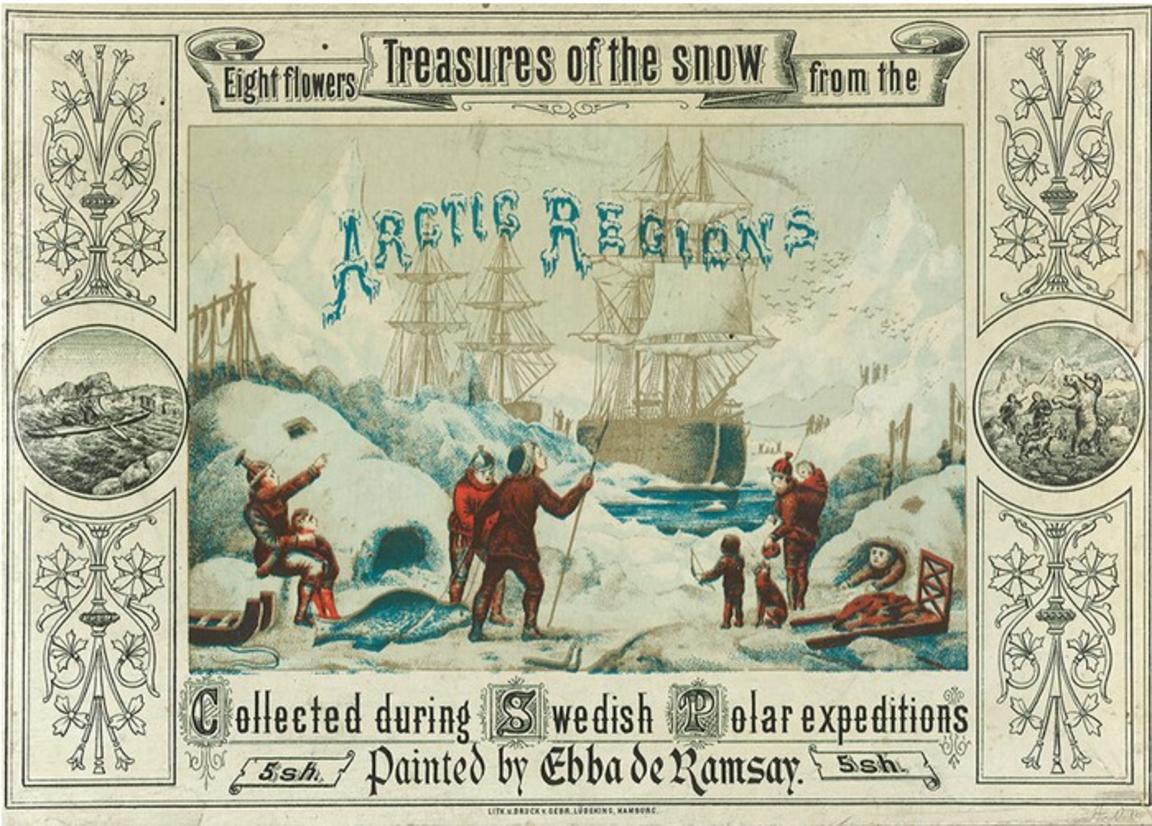
In later years, the areas surrounding the poles have maintained their attraction, and given rise to artistic creation both in Sweden and abroad. The Andrée expedition alone, spectacular and of worldwide renown in its time, has prompted several novels and other literary works, an opera, a song cycle, a dramatic play and so on. Several artists, both Swedish and foreign, have drawn upon the Arctic and the Antarctic for their motifs through the years. Early expeditions often included a graphic artist among their members, for the purpose of recording in images the journey itself and the locations it found. Initially, this was done because of the lack of photographic imaging technology, as yet undeveloped. People relied instead on lithographies, xylographies and other similar methods of illustration. Such images were often later included in the printed expedition records and travelogues, providing additional, intrinsic artistic value beyond the text itself. Swedish examples include the early expedition accounts from Spitsbergen in the 1860s, with their handsome illustrations in the form of lithographic leaves. The tradition of involving artists and writers in the expeditions has continued within modern Swedish Polar research.
In this way, artists such as Roland Svensson, Gunnar Brusewitz, Lars Lerin, Jakob Wegelius and Gösta Werner have accompanied Swedish Polar expeditions, and rendered them in images and books. Authors including Per Olof Sundman (Ingenjör Andrées luftfärd), Johan Pettersson (Målaren i Makarovbassängen), Majgull Axelsson (Is och vatten, vatten och is), and later Gunnar D. Hansson (Lomonosovryggen), have accompanied expeditions on various occasions, rendering impressions in literary form. Filmmaker and director Jan Troell, fascinated by the fate of Andrée, depicted it in a feature film (Ingenjör Andrées luftfärd) and a dramatized documentary (En frusen dröm).
Author Vidar Berge published a novel in Sweden in 1902, titled Den hemlighetsfulla Nordpolsön. The book included motifs from the balloon expedition, and in this context it is worth mentioning that Andrées project, as well as balloon flight in Arctic regions in general, was subject to a certain literary interest abroad and in Sweden, both among its contemporaries and in later years. In Germany, author Kurd Lasswitz published a science fiction novel titled Auf Zwei Planeten in 1897. It could be considered immediately inspired by the Andrée expedition, and has the balloonists encountering Martians at the North Pole. Denmark saw the publication of Laurits Johansen's Til Nordpolen pr. Ballon, as well as Carl Muusman's Nordpolens hemmelighed: Andrées efterladte papirer. In England, the pseudonym Côlas Milreis issued By Ballon to the Pole in 1895, and in the US, Leon Lewis published his novel Andrée at the North Pole. With Details of his Fate in 1898.
In later years, the expedition has been rendered in fiction by, among others, Macdonald Harris (The Balloonist), George MacBeth (Anna’s book) and David Hempleman-Adams (At the mercy of the winds). The Andrée expedition has also featured as a comic book by Torstein Landström (Andrées polarexpedition 1896) and as a children's book by Peter Gissy (Örnen har lyft). One visual interpretation of the Andrée expedition is that of Danish conceptual artist Joachim Koester: Message from Andrée. Using 16 mm film, Koester has retaken the photographs by Nils Strindberg, from the trek across the ice towards Vitön in 1897, focusing solely on the spots occurring on the negatives as a result of them being encased for some 30 years in the polar ice. The result is a strange blend of flickering and dots, intended to penetrate behind the already existing, well-known images and stories from the expedition. The work was shown at the 2005 Venice Biennal, and examples of the film footage were published in the same year, in the volume Message from Andrée, with texts by Anders Kreuger.
Composers and dancers have also found inspiration in the Polar environments and the history of the various expeditions, including composer Karin Rehnqvist (Arktis, Arktis) and Klas Torstensson (Expeditionen and The Last Diary) as well as choreographer Efva Lilja (Danskonst i fruset landskap). These works have later been performed in various contexts and at different venues. In 2000, the performance Arktis i tid och rum was staged in, among other places, Dramaten in Stockholm. A story about historic exploration and modern Polar research, with a concept and script by Anders Karlqvist, and starring Margareta Krook among others. In 2009, the closet drama Fade to White, based on Andrée's expedition to the North Pole was performed in the city of Gränna by American professor of drama Anne-Charlotte Hanes Harvey.
History of Antarctic and Arctic exploration


Photographs
in Alvin.
Read more
Bibliographies, library catalogues, databases (Open Access)
Arktiske Billeder Arktisk Institut, Copenhagen
Scott Polar Research Institute SPRI
The Arctic Science and Technology Information System (ASTIS) University of Calgary
Polar bibliography 1993- Swedish Polar Research Secretariat
Northern Research Portal University of Saskatchewan
Antarctic bibliography American Geological Institute
Websites Arctic/Antarctic
Swedish Polar Research Secretariat
Arctic Portal Arctic Council
Research institutes
Arktiskt Centrum vid Umeå universitet (Arcum)
ARCUS forskarbas inom arktiska områden
Arctic Research Consortium of the United States ARCUS
International Arctic Science Committee IASC
Archives with historical collections
Centrum för vetenskapshistoria, Kungliga Vetenskapsakademien, Stockholm
Grenna Museum, Andréexpeditionen Polarcenter, Gränna
Nationell arkivdatabas Riksarkivet Stockholm
International Arctic Research Center, University of Alaska Fairbanks
Scientific journals(OA)
Arctic Arctic Institute of North America, ISSN: 1923-124
Arctic Review on Law and Politics, eISSN 2387-4562
Polar Research Norwegian Polar Institute, eISSN 1751-8369
Polish Polar Research Polish Academy of Sciences, e-ISSN: 2081-8262
Polarforschung Die Zeitschrift der Deutschen Gesellschaft für Polarforschung, e-ISSN: 2190-1090
Scientific journals
Journal of Northern Studies Umeå University
Digital research archives
ePIC Institutional Repository Alfred-Wegener-Instituts für Polar- und Meeresforschung (Tyskland)